3.1 Product Dimensions, Weight & Bag Size
Everything starts with the product itself.
Product dimensions and weight influence nearly every packaging decision. Dimensions determine the required bag size, while weight affects paper thickness, handle selection, and structural strength.
If products are packed inside retail cartons or gift boxes, the final packaged dimensions should be used rather than the product dimensions alone.
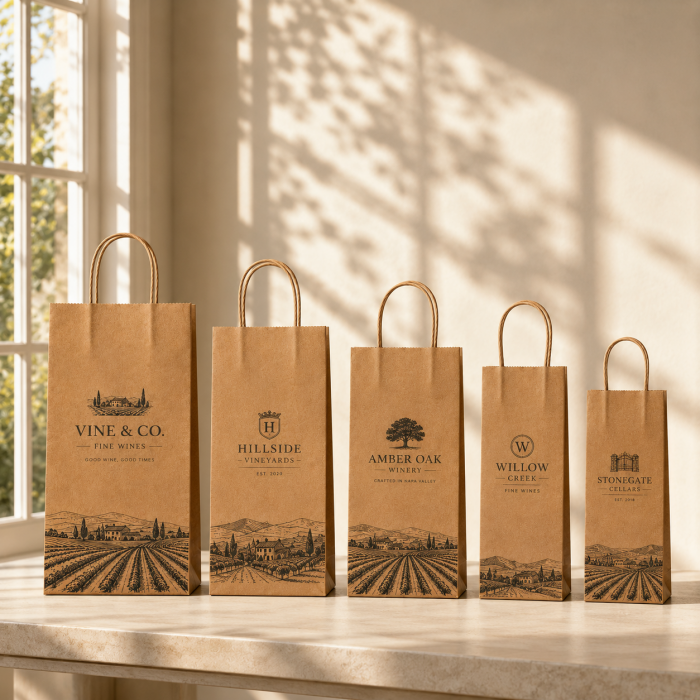
Paper bag dimensions are typically expressed as Width × Gusset × Height, for example 30 × 12 × 40 cm.
Choosing the correct dimensions directly impacts both usability and cost. Bags that are too small may create fitting issues and place unnecessary stress on the structure. Bags that are too large increase material consumption and shipping volume.
In most projects, allowing a small amount of clearance around the product is enough to ensure a comfortable fit without wasting materials.
Proper sizing improves customer experience, reduces packaging waste, and can lower transportation costs over large production runs.
3.2 Choosing the Right Paper Material
Material selection affects strength, print quality, appearance, sustainability, and overall project cost.
| Kraft Paper |
Widely used in retail, food service, and takeaway packaging. It offers a natural appearance, good durability, and cost efficiency for everyday applications. |
| White Kraft Paper |
Provides a cleaner printing surface while maintaining similar structural performance. It is often selected when accurate color reproduction and brand consistency are important. |
| Art Paper |
Commonly used in premium packaging projects. It supports detailed graphics, luxury finishes, and enhanced visual presentation. |
The best material choice should be based on product requirements and brand positioning rather than appearance alone.
Sustainability is also becoming an important purchasing factor. Many brands now prefer FSC-certified paper, recyclable materials, and water-based printing inks to support environmental goals while maintaining packaging performance.
3.3 Printing Requirements & Artwork Files
Printing preparation is one of the most common causes of project delays.
Before contacting suppliers, it helps to prepare:
- Logo files
- Brand guidelines
- Pantone color references
- Printing coverage requirements
- Artwork placement instructions
Complete information allows suppliers to recommend suitable printing methods and estimate costs more accurately.
| Preferred File Formats |
AI (.ai), EPS (.eps), Vector PDF (.pdf) |
| File Formats That Often Require Revision |
JPG, Screenshot Images, PowerPoint Files, Low-Resolution PNG Files |
Vector artwork helps maintain accurate logo proportions, color consistency, and print quality throughout production. Preparing artwork correctly can significantly reduce proofing and prepress preparation time.
3.4 Order Quantity & Delivery Timeline
Order quantity has a direct influence on unit pricing and production planning.
When requesting a quotation, it is helpful to provide:
- Initial order quantity
- Estimated annual demand
- Expected reorder frequency
Even a rough forecast allows suppliers to optimize production planning and sometimes reduce overall packaging costs.
Lead time includes much more than manufacturing. A complete project timeline typically includes artwork approval, sample production, sample confirmation, mass production, and shipping.
Many project delays occur because one or more of these stages are overlooked during planning. Working backward from the target launch date is often more reliable than estimating forward.